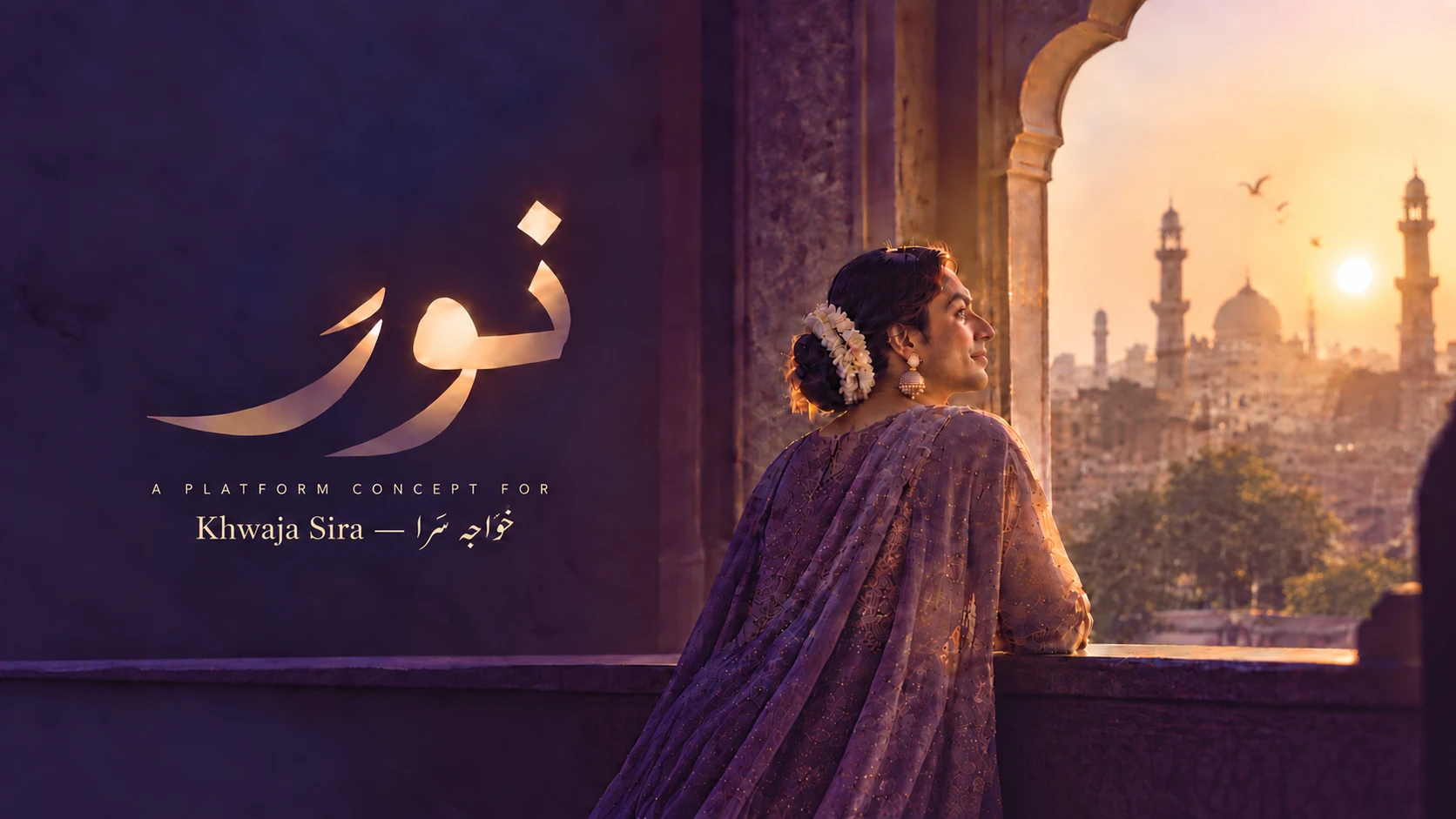
Designing dignity into Pakistan's first Third Gender platform
Design has a responsibility to the people it claims to serve. Pakistan's Khwaja Sira community has been excluded from every digital platform that exists. Noor is an attempt to change that: a platform built from 16 research sessions, in Urdu and Punjabi, with the community itself.
Role
Lead UX Designer
Timeline
20 weeks
Research
16 participants, 3 cities
Citations
33 sources
Status
Seeking partnersResearch and design are complete. Usability testing hasn't been run yet — building and validating this responsibly needs an NGO, government, or grant partner.
~35 min read · Comprehensive research case study
Noor
نور — Light
Overview
A community of half a million people with zero digital platforms that work
Pakistan's Khwaja Sira — the Third Gender, legally recognised by the Supreme Court since 2009 — has been building its own kinship structures, spiritual traditions and informal economy for centuries. What it has never had is a piece of software designed for it, by people who actually spoke with it.
One attempt exists. DhanakApp launched in 2024 as a generic "LGBTQ+ and minority" app, built without community research. It has ten downloads. That failure is not a footnote in this case study — it's the starting brief. A platform built on assumption, however well-intentioned, is indistinguishable from one that was never built at all.
Noor started from the opposite instinct: spend the first four weeks not designing anything, and instead find out what a trustworthy product would even need to do.
Discover→Define→Ideate→Design→Test→Handoff→Launch
16Khwaja Sira participants interviewed directly, across Lahore, Karachi and Rawalpindi
180+raw insight fragments extracted and clustered into six affinity groups
5service modules, each mapped directly to a research finding — not a generic app template
Scope · Read this first
Why Noor is not an LGBTQ+ platform
This distinction shaped every decision that followed, so it comes before the process. It is the single most important framing choice in the entire project.
Design scope
Noor is designed solely for Pakistan's Third Gender — Khwaja Sira, Hijra, Khusra, Zenana. This is not an LGBTQ+ platform.
Khwaja Sira identity is a distinct, pre-colonial South Asian cultural and spiritual identity — not the Western LGBTQ+ construct. Their history dates to the Mughal era, when they held respected court positions and spiritual roles at Sufi shrines. They have been legally recognised as a Third Gender in Pakistan since the Supreme Court ruling of 2009 — years before most Western trans-rights legislation existed. Grouping them under a Western LGBTQ+ umbrella erases their specific cultural identity, their guru-chela kinship system, their Sufi spiritual traditions and their own internal language, Farsi Kalam. DhanakApp tried the generic framing. It reached ten downloads. Noor is built from sixteen direct research sessions with the community itself.
Community terms
Khwaja Sira خواجہ سرا — Mughal-era court term, the most respected in Pakistan today Hijra ہجڑہ — South Asian umbrella term, used across Pakistan, India and Bangladesh Khusra خسرہ — Punjabi term, informal register Zenana — effeminate male, a distinct sub-identity Mukhannas — an Islamic theological category
What makes this identity distinct
Guru-chela kinship — a structured dera household led by a guru Farsi Kalam — the community's own internal language Sufi spiritual tradition — shrines, blessings, spiritual authority Pre-colonial recognition — respected advisors in Mughal courts Legal status since 2009 — a Supreme Court ruling
Why this product exists
80% denied formal employment (UNDP, 2024) 92% face healthcare discrimination (FDI & Blue Veins, 2018) 56% depression prevalence (PJMS, 2022) 0 dedicated digital platforms that actually work 10 downloads — the only prior attempt
Before the research
The bus journey that changed the question
Noor didn't start with a feature list. It started with things I'd never examined closely enough.
Growing up, a Khwaja Sira person visited my village at weddings, festivals and births — welcomed into homes, known by name, part of the community. Later, in bigger cities, I saw a different kind of visibility: begging at traffic signals, performing at functions, working in conditions that looked unsafe or humiliating. I didn't yet understand the systems behind what I was seeing — I just wondered why people didn't find different work, or challenge how they were treated.
For nearly a year I rode Lahore's Speedo buses, and regularly watched Khwaja Sira passengers get stared at and mocked for doing something as ordinary as commuting. One day I intervened, and ended up talking with the passenger in Punjabi and Urdu until their stop came. The questions I asked were shaped by my own limited understanding — I thought they were practical questions. I later realised they placed the burden on the person experiencing exclusion, not on the systems producing it.
The useful question wasn't "Why don't they defend themselves?" — it was "Why must they keep defending their right to participate in ordinary life?"
That conversation wasn't research — one person can't represent a community. But it gave me a reason to investigate my own assumptions before trying to design an answer for anyone else's life.
Discover · Secondary research
Four weeks of reading before a single interview
Before I asked anyone to trust me with their story, I did the reading. Twenty-four secondary sources — government census data, peer-reviewed clinical studies, NGO field reports, and 2024–2026 legal analyses — to arrive at interviews already understanding the landscape, instead of asking participants to educate me from zero.
The numbers alone explain why a platform like this cannot be a side project. This is a population living with compounding, documented exclusion across employment, healthcare, education and legal recognition.
92%
face healthcare discrimination — refusal, abuse or violence
80%
denied formal employment because of Third Gender identity
Pakistan passed the Transgender Persons (Protection of Rights) Act in 2018. The bigger design lesson from reading it wasn't the law itself — it was that having a right and being able to exercise it are two different experiences.
A right to education doesn't stop harassment at the school gate, on the bus, or in the classroom.
A right to employment doesn't stop rejection once an employer learns someone's identity.
A right to healthcare doesn't guarantee respectful treatment from reception staff or clinicians.
A CNIC reflecting someone's real gender doesn't create privacy in a market, workplace or bus.
A right becomes meaningful when a person can exercise it safely in everyday life.
Ideate · Before primary research
Challenging the first idea before designing it
My earliest hypothesis was a private platform where the community could learn, earn and connect without hiding. Before designing it, I had to challenge whether it should exist at all.
Facebook, Instagram, WhatsApp and Reddit already had reach, familiarity and mature tooling. A separate platform risked isolating the community further instead of including it. The gap wasn't that mainstream platforms had no safety features — it's that safety and local context were secondary settings, not foundations.
What if dignity and privacy weren't settings people had to discover, but the starting conditions of the experience?
Discover · Primary research
Sixteen sessions, in Urdu, with no recordings
I ran semi-structured interviews with 16 Khwaja Sira community members across Lahore, Karachi and Rawalpindi, recruited through guru networks and NGO partners rather than open calls — trust travels through existing relationships in this community, not through recruitment forms.
Every session was conducted in Urdu or Punjabi. None were recorded. Handwritten notes only, transcribed and anonymised immediately afterward — a methodology decision, not a convenience. Participants had documented reasons to distrust anything that could be screenshotted, leaked or used against them, and a recording device in the room would have undermined the research before it started.
16semi-structured interviews, 45–90 minutes each, across three cities
180+insight fragments extracted from handwritten session notes
0audio or video recordings — handwritten notes only, by design
Participant income sources (n=16): badhai / ritual work (5), craft & tailoring (4), sex work (3), NGO / formal employment (2), content & digital art (1), domestic work (1). Thirteen of sixteen participants had a skilled trade. None had a safe market to sell it in.
The discussion guide
Refined after the first two sessions, once it was clear a few questions read as interrogation rather than conversation. Each session moved from safe, everyday ground toward more sensitive territory — never the reverse — and no participant was asked to explain or justify their identity at any point.
The guide as used across all sixteen sessions, grouped by phase with target timing — not a fixed script, a conversation scaffold.
Opening, ~5 min — "Tell me a little about your day-to-day — what does a normal week look like for you?" / "How did you first connect with your guru or community here?"
Work & livelihood, ~15 min — "What kind of work do you do now, and how did you learn it?" / "Walk me through what happens when you try to take on new work or sell something — what usually gets in the way?" / "Has there been a moment recently you felt proud of something you made or did?"
Trust & technology, ~15 min — "How do you feel about using apps like WhatsApp or Facebook for things that really matter to you?" / "Has anything online ever made you more careful afterward? What changed?" / "If a new app asked you to sign up today, what would make you trust it — or not?"
Rights, health & information, ~15 min — "What do you know about your legal rights as a citizen, and where did that come from, if anywhere?" / "When you've needed medical care, what was that like?" / "Who do you turn to first when something is really weighing on you?"
Community & belonging, ~10 min — "If you had to move to a new city tomorrow, what would you miss most about your community here?" / "What does it mean to you to belong somewhere?"
Closing, ~5 min — "If you could design one thing that made tomorrow easier, what would it be?" / "Is there anything I didn't ask that you wish I had?"
Research ethics and representation
Taking part in research doesn't automatically grant permission to publish someone's identity, face or personal history. Every quote in this case study is anonymised and reconstructed from handwritten notes, not a verbatim transcript — and any recognisable imagery would need separate, explicit consent for portfolio publication. The visual story should show artists, learners, workers and community leaders — not a sequence of portraits designed to prove hardship.
Observation was not explanation
Before the interviews, I'd noticed some participants behaved differently across social situations, and my early read was that this was simply identity. Research suggested something else: behaviour can be protection. What looks confrontational to an outsider can discourage harassment. What looks like withdrawal can be a way of staying safe.
The question changed from "Why do they choose this life?" to "What choices remain after society has removed most of the alternatives?"
Discover · Key research findings
Six findings that reshaped what "MVP" meant
These weren't the findings I expected going in. Several of them — the trust deficit above all — inverted assumptions I'd carried from every other consumer product I'd designed before this one.
"We have been filmed and put on the internet without permission. Every phone is a weapon until we see otherwise." — P7, guru, 38
Every single participant expressed deep suspicion of digital platforms before engaging, grounded in documented algorithmic hostility and personal experience of doxxing and screenshot-based harassment.
UX implicationPrivacy controls appear before any value exchange. The onboarding pattern is inverted from industry standard.
"I make wedding suits. My work is as good as anyone on Instagram. But when they find out who I am, they cancel." — P2, tailor, 31
Tailoring, embroidery, beauty, digital art, cooking — the skills exist. Identity-based exploitation at the point of transaction blocks every existing marketplace for this community.
UX implicationEscrow plus an identity-protected marketplace is a direct income intervention — economic, not merely social.
"I didn't know I could get a CNIC with my real gender. I found out from a WhatsApp post two years ago." — P11, student, 21
CNIC rights, employment protections, education rights — mostly unknown to the majority, corroborating existing Williams Institute research showing very low community awareness of the Act.
UX implicationA legal rights hub in plain Urdu Nastaliq is MVP, not V2. It changes lives in the first session.
"When I moved from Lahore, I had nothing. If I could have found my community without going street by street, my first two years would have been different." — P4, salon owner, 44
Most of Pakistan's Third Gender population lives in urban areas. Migration is common; the dera social safety net does not travel. A 2025 peer-reviewed study confirms that relocating Khwaja Sira lose their entire support structure and restart from zero.
UX implicationA city-based guru network, searchable by location. Dera finder scheduled for V1.1.
"The psychologist laughed. I never went back to any doctor for that." — P5, 27
All sixteen participants described depression, anxiety, or trauma. All described avoiding professional mental health support after hostile experiences — consistent with the 92% healthcare discrimination rate documented in secondary research.
UX implicationTrained peer listeners must precede professional referral. Text-first, for use in shared spaces.
"I want to study but I cannot sit in a classroom. They make my life hell. If I could learn at home, I would study every day." — P3, 19
Six of sixteen had no education beyond primary level; four never attended school. Independent research documents over 90% of trans students in Rawalpindi/Islamabad reporting institutional discrimination. Physical classroom attendance is not a viable design assumption.
UX implicationBISE-aligned home education with offline download, and an audio-only fallback for weak connections.
What research changed in me — and in the product
The most useful output of research wasn't a features list. It was a change in how I framed the problem itself.
Initial assumption
What research revealed
Effect on Noor
Why don't people defend themselves?
Speaking up can carry real social, economic and physical cost
Safety and control became product requirements, not expectations placed on the user
Why don't people know or use their rights?
Information can be legally available while staying fragmented, outdated or unsafe to act on
Madad focused on plain language, sourcing and qualified referral
Why do people depend on informal work?
Exclusion from education, employment and finance restricts the choices available
Hunar focused on existing skill and safer market access, not new training
Do visible behaviours reflect identity?
Assertiveness, withdrawal and adaptation can also be survival strategies
The product stopped treating behaviour as something to correct
Define · Synthesis
180 fragments, sorted into six clusters and one shared feeling
Affinity mapping turned scattered notes into a shape I could design against. Six clusters emerged, ranked here by volume of evidence rather than by any assumption I walked in with.
FigJam — Raw affinity mapping boardnoor-affinity-board.jpg
180+ sticky notes, clustered and re-clustered over several passes before the six groupings below held up.
Pakistan's Khwaja Sira / Hijra / Third Gender community have real skills, deep community bonds, and a desire for dignified participation — but lack a trusted, safe digital space to learn, earn, connect, and access their rights, without risking their safety, privacy, or economic precarity.
Define · Decision-making principles
Five principles for making every decision after this one
Everything from the IA to the visual system had to answer to these — not just the problem statement.
Privacy before participation — explain what's collected, what isn't, and where protection ends, before asking for anything.
Dignity without charity language — represent people through ability and ambition, not only disadvantage.
Local language as infrastructure — Urdu and Punjabi shaped the research; Urdu couldn't become a translated layer bolted onto an English design.
Verification with minimum disclosure — verify only what a specific action requires, never collect sensitive identity data without a defined purpose.
Community governance, not only community testing — community members get real decision-making roles in moderation, content review and safety policy, not just a seat as research subjects.
Define · Personas
Four people, not one composite user
I resisted collapsing sixteen participants into a single archetype. The range of need was too wide — a 17-year-old wanting to finish school and a 38-year-old guru managing a twelve-person household need genuinely different things from the same product.
Z
Zara, 24 — "The Hidden Artist"
Digital artist · Lahore dera · Mehendi + badhai
"My art doesn't have a gender. But the internet always finds out mine."
Goals
Sell artwork without harassmentFind affirming therapist
Pain points
Accounts flagged by algorithmsBuyers cancel when identity revealed
Key Noor need — an identity-protected marketplace where buyers see the work, not who made it, with escrow so she can't be cheated after delivery.
S
Sheila (Guru), 38 — "The Pillar"
Guru · 12-person dera · Rawalpindi · 15 years
"I am responsible for twelve lives. Give me the tools and I will take care of everything else."
Goals
Legitimate income for chelasConnect with other gurus
Pain points
No trusted resource hubRoutine healthcare refusals
Key Noor need — a verified guru network by city, a community-vetted healthcare directory, and a plain-Urdu legal rights hub.
K
Kanwal, 21 — "The Navigator"
CS student · Intersex · Lahore · Not publicly out
"I want to talk to someone who gets it, without showing my face first."
Goals
Connect anonymously firstSafe freelance income
Pain points
No anonymous entry pointFeels surveilled on campus
Key Noor need — anonymous-by-default community entry, peer-listener matching with hidden identity, and text-first sessions.
R
Roshan, 17 — "The Learner"
Left school age 13 · Rawalpindi dera · Dreams of nursing
"I want to study every day. I just need someone to teach me safely."
Goals
Complete Matric from homeEarn independently
Pain points
School violenceBudget Android only
Key Noor need — BISE-aligned classes with offline download, an audio-only fallback on weak 3G, and a certificate she can show a future employer.
FigJam — Persona synthesis boardnoor-persona-synthesis.jpg
Sixteen participant profiles grouped by need pattern, not by demographic — age and city varied within each persona.
Ideate · Competitive analysis
Everything that exists, and why it hasn't worked
Four categories of "existing solution" turned up in research: a failed app, a violence-reporting NGO tool, an Indian platform with no Pakistan context, and WhatsApp groups that infiltrate and dissolve. None of them cover the ground this community actually needs covered.
Platform
Education
Marketplace
Community
Safety
3rd Gender specific
Gap
DhanakApp (BizzInnova, 2024)
✗
✗
△
✗
✗
10 downloads · LGBTQ+ umbrella · zero community research
Trans-Muhafiz (Blue Veins)
✗
✗
✗
△
△
Violence reporting only · KPK focus · no life features
PeriFerry (India)
△
△
✗
✗
✗
Not mobile-first · no Pakistan context
WhatsApp groups
✗
✗
△
✗
△
Ephemeral · infiltrated · no structure · no safety
Noor ← this product
✓
✓
✓
✓
✓
First mover. Research-backed. DhanakApp proved generic fails.
Ideate · Information architecture
Five modules, named in Urdu, structured around the six findings
The IA is not a features list dressed up as a sitemap. Each of the five tabs maps directly onto one or more research findings — there is no module in Noor that exists because it's a common app pattern rather than because a participant needed it.
نور — Noor App
گھر Home
Personalised feed
Talent spotlight
Resource alerts
تعلیم Taleem
Class dashboard
Live class player
Recorded library
Quiz & progress
ہنر Hunar
My storefront
Browse talent
Escrow & orders
Earnings
سفر Safar
City feed
Guru network
Private circles
مدد Madad
Peer listener
Know your rights
Healthcare directory
Crisis resources
Tap a module to focus it · tap again to reset
FigJam — Card sorting & IA sketchnoor-ia-cardsort.jpg
Early groupings tested with three participants before settling on five modules — two candidate structures were dropped here, not later.
A layered access model
A community-specific space creates a real tension: open access lets hostile outsiders in; mandatory legal ID excludes people with incomplete records, or good reason to avoid linking government identity to a sensitive platform. Access strengthens only as the risk of the action increases.
Open access — public legal, healthcare and education resources, no account needed.
Pseudonymous access — low-risk browsing and saved content under a display name.
Community verification — social participation through authorised partner organisations.
NADRA-supported verification — an optional institutional route for eligible users.
Enhanced verification — feature-specific checks for selling, withdrawal and disputes.
Ideate · Key user flows
Three flows that carried the highest research risk
Onboarding, the marketplace transaction, and a feature that isn't really a feature at all — a safety toolkit that makes every other screen feel safe enough to open.
Onboarding · Privacy first
Zara · new user · trust deficit
Language select (Urdu shown first) → privacy promise, three screens before any data is collected → display name, not required to match legal identity → visibility setting, shown with visual examples → home feed, no further gates.
Key decision — privacy controls appear before any data is asked for. This inverts the standard onboarding pattern deliberately.
Marketplace · Identity protected
Zara · selling embroidery
Create listing with a suggested auto-watermark → set a fixed price or accept offers → an inquiry arrives showing the buyer the work, not the seller's identity → accept and escrow initiates, holding payment → deliver, and payment releases after a 7-day moderator-reviewed window.
Key decision — escrow is mandatory, not optional. It prevents the non-payment exploitation documented directly in research.
Safety Toolkit · Zero friction
Any user · hostile device access
A persistent shield icon stays visible on every screen → one tap hides the profile and all activity instantly, no confirmation step → a pre-configured trusted contact is alerted with location → a crisis resource displays immediately, no navigation required. An early version explored an OS-level power-button trigger; technical review showed a third-party app can't reliably guarantee that across Android devices, so the interaction was rebuilt inside what the product can actually promise.
Key decision — this isn't a feature. It's the feature that makes every other feature feel safe enough to use at all — and it should never claim more safety than it can deliver.
Ideate · Prioritization
MoSCoW, driven by which finding a feature answers
Sixty-four candidate features came out of ideation. I prioritized by asking one question of each: which of the six research findings does this address, and does the product still work without it? Anything that couldn't answer that question honestly moved to "Won't have."
Must have — MVP
Findings 1–6
Privacy-first onboarding
In-app safety toolkit
Community feed (Safar)
Legal & healthcare hub
Urdu Nastaliq throughout
Offline resource caching
Should have — V1.1
Core value delivery
Full escrow marketplace
JazzCash / EasyPaisa
Peer listener matching
Education module K–12
Guru network directory
Could have — V2.0
Needs partner infrastructure
Live streaming classes
NAVTTC-verified certificates
Affirming therapist directory
Micro-grant integration
Dera finder (map level)
Won't have
Safety and trust reasons
Open-access API
Video content by default
Social login, any provider
Location tracking
Ads — ever
FigJam — Ideation wallnoor-ideation-wall.jpg
Sixty-four candidate features sketched before prioritization — including the five below that didn't survive contact with research or technical reality.
Ideas rejected or reframed
Early concepts were useful because they exposed assumptions — some didn't survive contact with research or technical reality.
Early direction
Why it looked useful
What made it weak or unsafe
Decision
Open map of dera locations
Easy local discovery
Could expose sensitive locations and the people connected to them
Rejected — controlled introductions instead
Mandatory legal identity at entry
Discourages hostile outsiders
Excludes people with incomplete documents; increases fear
Rejected — layered access instead
Launching every module at once
A complete concept on day one
Requires running a social network, legal hub, payments and a school simultaneously
Reframed — four phases
OS-level power-button panic trigger
Fast, discreet, works with the screen off
A third-party app can't reliably guarantee that behaviour across Android devices
Reframed — persistent in-app safety toolkit
Direct Urdu translation of "escrow"
Kept the correct terminology
No natural Urdu equivalent, and financial jargon risks reading as a scam term
Why this matters: the product should never promise a physical-safety guarantee through an interaction it can't reliably deliver. The safety toolkit does what it can actually do — hide the profile, alert a trusted contact, surface a crisis resource — inside the boundaries of what a normal app is allowed to control.
Design · Visual system
No pink, no rainbow, no generic AI aesthetic
Colour was a research decision before it was an aesthetic one. Every hue traces back to Mughal-era South Asian textile tradition — the community's own visual heritage — rather than any imposed external symbolism. Typography carried the same weight: Nastaliq over Naskh, even though it's technically harder to implement, because it's the script this community actually reads.
Deep Violet
#3B2A6E
Primary — dignity, South Asian textile
Amber
#F5A623
Accent — warmth, Mughal palette
Teal
#1D9E75
Verified, affirming, safe states
Coral
#FF5E3A
Action — warm, not alarming
Near-black
#1E1C21
Text — max contrast, worn screens
Off-white
#FAF8F5
Surface — warm, not clinical white
No pink/rainbow or LGBTQ+ palette. Avoiding an imposed external identity symbolism was a design decision, not a style preference.
Primary — all Urdu text
خواجہ سرا
نور — روشنی کا سفر
Noto Nastaliq Urdu
Nastaliq is the culturally authentic script traditionally used for Urdu — newspapers, signage, literature. Choosing Naskh, the technically simpler option, would have signalled developer convenience over community respect. The overhead is deliberate.
Secondary — English, numerics, labels
Noor
DM Sans, weights 300–600. Body copy is enforced at a 16sp minimum — a deliberate accessibility floor, since several participants used low-cost Android devices with worn, hard-to-read screens.
Accessibility requirements
16sp minimum for functional body text
High-contrast colour pairs throughout — never colour alone to carry meaning
Text labels beside every icon — no icon-only navigation
Reduced dependence on gestures; primary actions reachable with a single tap
Urdu-first comprehension testing, not translation after an English design
Low-bandwidth and fully offline states for every core flow
Audio alternatives where reading isn't safe or reliable
Design · Wireframes
Paper first, designed for the phones participants actually described
Low-fidelity wireframes were sketched in Urdu before any pixel was pushed, referencing the budget Android hardware participants described using in interviews — not a design team's flagship phones. Four screens carried the highest research weight. These are design decisions grounded in what participants said, not results from testing the wireframes themselves — that step hasn't happened yet.
FigJam — Paper wireframe sketchesnoor-paper-wireframes.jpg
Sketched in Urdu first — translating an English-first layout after the fact was the single most common IA mistake this research uncovered.
🛡
آپ کا ڈیٹا محفوظ ہے
Your data is safe
Onboarding
نور
Home feed
🛡
آپ محفوظ ہیں
Safety Toolkit
حق — آپ کے قانونی حقوق
Haq — Legal Rights
Test · Validation plan
Validation is the next step — not a result I already have
Everything through prototyping was built from and checked against the 16 primary interviews and the affinity-mapped findings. What hasn't happened yet is formal usability testing with participants — no moderated sessions, no measured SUS score, no task-completion data. I want to be direct about that rather than let a testing section imply otherwise.
The reason is the same one that shaped the interviews in the first place: testing this responsibly — in Urdu, with the community, on their actual hardware, without creating new exposure risk — needs the kind of ongoing trust and safeguarding a solo case study can't provide on its own. That's part of what a development partner is for.
How I'd validate it
Paper, then mid-fidelity, then hi-fidelity prototypes — moderated sessions conducted in Urdu, not translated after the fact.
Testing on the same low-cost Android hardware participants described using, not flagship devices.
Task-based success measurement plus a System Usability Scale benchmark, reported honestly against the industry baseline whatever it turns out to be.
Specific attention to whether financial terms like "escrow" are understood without translation, and whether the safety toolkit is discoverable without being shown where to look.
Those last two are open questions drawn from what participants said in interviews — not testing results. They're the first things I'd want to check.
External context · Journalism and documentary coverage
The world this product would enter
Noor was not designed in isolation from current events. The research period coincided with documented attacks, legal challenges to the 2018 Act, and ongoing international journalism covering Pakistan's Khwaja Sira community. These are not Noor's sources — they are the reality any responsible product must acknowledge.
Supreme Court of Pakistan. Dr Muhammad Aslam Khaki v. SSP (Operations) Rawalpindi. Constitutional Petition No. 43 of 2009.
National Assembly of Pakistan. Transgender Persons (Protection of Rights) Act, 2018.
Pakistan Bureau of Statistics. 6th Population and Housing Census 2017 — Third Gender count: 10,418 (estimated undercount).
UNDP Pakistan. Transcending Binaries: Gender Justice in Pakistan, 2024.
Tabassum, S. & Jamil, S. Depression prevalence among transgender individuals in Lahore. Pakistan Journal of Medical Sciences, 2022; 38(7), n=214.
FDI & Blue Veins. Healthcare discrimination against transgender persons in KPK, 2018. 92% reported refusal, abuse or violence.
Williams Institute, UCLA. Transgender rights awareness in Pakistan: knowledge gap analysis, 2023.
Mughal, A. W. Relocating Khwaja Sira: loss of dera support networks during urban migration. South Asian Studies, 2025.
Hussain, M. et al. Educational exclusion of transgender students in Rawalpindi/Islamabad. Journal of Education & Social Sciences, 2024.
Dawn. Pakistan's transgender community: Still fighting for basic rights despite legal protections. 2024.
Al Jazeera. Why is Pakistan's transgender community under attack? 101 East, March 2024.
Reuters. Pakistan passes landmark transgender rights law. May 2018.
Human Rights Watch. Pakistan: Transgender People Under Attack. 2024.
BBC News. Pakistan's transgender community demands rights and recognition. World Asia.
DW News. Pakistan's transgender community fights for survival. Documentary report.
Brooke, J. DhanakApp (BizzInnova) — post-launch user analysis. Google Play Store data, 2024. 10 total downloads.
Scope · What's real, and what's still needed
The interface was only the visible layer
Every promise on this screen depends on work behind it — this is where service design stops being a mockup skill and becomes an operating question. Noor touches sensitive identity, legal, healthcare, community, financial and safety contexts. It can't launch as an ordinary independent app.
Community governance + regulated financial partner
Learning pathway
Curriculum, assessment, recognised certification
Government or authorised education partner
Identity verification
Consent, minimum-data exchange, audit
Approved institutional pathway
Noor shouldn't be built and then handed to the community. Community members should help decide how it operates.
What Noor is — and what it deliberately isn't
Noor isn't an argument that the Khwaja Sira community should stay separate from wider society, and it isn't built on a belief that the community can't use mainstream technology. It isn't meant to correct anyone's behaviour, rescue anyone, or speak on their behalf. It's a claim about foundations: what digital participation could look like if local language, privacy and ambition were the starting architecture instead of edge cases — not a claim that an app can fix structural discrimination.
Research and product limitations
No usability testing has been conducted yet — every interaction decision here is grounded in the 16 research interviews and general accessibility reasoning, not in moderated testing results.
Sixteen qualitative participants can't represent every Khwaja Sira identity or experience in Pakistan.
Recruitment through trusted networks may under-represent people outside dera and NGO structures.
Handwritten notes reduced exposure risk but limited how much language can be treated as verbatim.
The marketplace still needs real financial, fraud, dispute and regulatory operations.
Legal and healthcare content needs continuous, qualified review, not a one-time write-up.
These limitations don't make the research meaningless — they define the work required before anyone builds this responsibly.
Reflection · What changed in my practice
The design is done. It still needs a partner to exist.
Noor is complete as a design artefact: research, information architecture, personas, a documented design system, and dev-ready handoff notes. It has not been usability-tested, and it is not yet a shipped product — I'm not going to dress either of those up as anything other than what they are.
Three habits from this project changed how I approach every subsequent engagement: recruit through trust networks, not open calls; treat "not recording the session" as a design decision, not a limitation; and let research findings veto features, not just inspire them. The trust-deficit finding alone inverted an onboarding pattern I'd used unquestioned on a dozen prior products.
Given the chance to continue this work, the priority is finding the right partner — an NGO with existing community trust, a government programme like Punjab's Pehchan initiative, or grant funding sized for an 18-month build — because a platform this sensitive should not be built and operated without accountability to the community it serves.
What should happen next
Not more polished screens — the partnerships and field evidence needed to decide whether this can become a responsible service: a compensated community advisory council, participatory threat modelling and an independent privacy review, an unmoderated field pilot of Phase 1, and a partner willing to own legal, healthcare and moderation work for the long term. Success here means safer access to meaningful choices — not download counts.
Honest status: research and design are complete. Usability testing has not been conducted — there is no SUS score, no completion-rate data, and no participant testing behind the interaction decisions shown here. This case study makes no claims about usability scores, retention, revenue, or real-world usage.
Available for new projects
Let's build something that treats people as more than a problem to solve
Noor is seeking NGO, government, and grant partners to develop and operate it responsibly. If that's you — or if you have a different problem worth this kind of process — I'd like to hear about it.